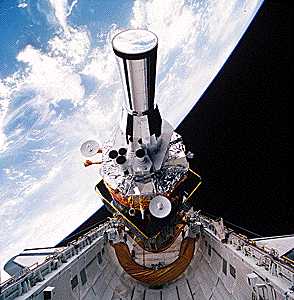
DSP Satellite
 The DSP Satellite and the FastWalker Incident - Discovery Channel - The DSP Satellite and the FastWalker Incident - Discovery Channel - 

Cosmic Conspiracy: Part Five, The 80s
Six Decades of Government UFO Cover-Ups
by Dennis Stacy and Patrick Huyghe
SOURCE : OMNI Magazine August 1994
Here we look at the 1980s. From their vantage point 22,300 miles above the
earth's surface, a fleet of supersecret military satellites monitors our
planet for missile launches and nuclear detonations. On a clear day, these
satellites can see forever, so it's no surprise when they also pick up erupting
volcanos, oil-well fires, incoming meteors, sunlight reflections off the
ocean, and a host of other heat sources, including those that still remain
unexplained. Since 1985, all this data has been beamed down in near real-time
to the U.S. Space Command's Missile Warning Center, operating from within
Cheyenne Mountain, near Colorado Springs. The purpose: coordinating satellite-based
early warning systems for the army, navy, air force, and marines.
Whether harmless or threatening, the information has always been a guarded
national secret. But suddenly, in 1993, with the Cold War over, the Defense
Department agreed to declassify some satellite information not related to
intercontinental ballistic missile (ICBM) launches and nuclear events. Since
then, scientists from astronomers to geophysicists have rushed to get their
hands on this motherlode of data. Among researchers hoping to glean some
truth from the declassified data are UFOlogists, long frustrated by the
critics' classic retort: "If UFOs are real, why haven't they been detected
by our satellites?" Well, some UFO researchers are now saying, they
have been.
With access to the most sophisticated space data ever generated, say some
UFO researchers, they may finally find the Holy Grail of their profession:
bona fide, irrefutable, nuts-and-bolts proof of UFOs. As this series of
articles explains, UFO researchers have been searching for such evidence
in government vaults for years. In the Fifties and Sixties, some UFOlogists
claimed, the military kept alien corpses and a ship under wraps. The search
for proof was fueled throughout the Seventies by the Freedom of Information
Act, which yielded thousands of pages of government documents, but no hard,
technical, incontrovertible evidence of UFOs.
Finally, in the 1980s, a supposedly explosive memo revealed the existence
of a top-secret group, dubbed MJ12, made up of high-level government officials
devoted to the secret reality of UFOs. Only problem is, according to most
UFO experts, the memo was a hoax. Of course, data from crude detection systems
like gun cameras and radar were available. But they merely confirmed the
obvious: that military and government personnel, like many other sectors
of the population, saw and reported mysterious lights in the sky. If they
could ever prove their theories, UFOlogists knew, they would have to tap
the most sophisticated information-gathering technology available: Department
of Defense spy satellites, like the Defense Support Program (DSP) satellites,
in geo-synchronous orbit above the earth.
In fact, rumor had it, heat, light, and infrared sensors at the heart of
the satellites were routinely picking up moving targets clearly not missiles
and tagged "Valid IR Source." Some of these targets were given
the mysterious code name of "Fast Walker." Unfortunately for UFOlogists,
few secrets in this country's vast military arsenal have been so closely
guarded as the operational parameters of DSP satellites. Even their exact
number is classified. "That shouldn't surprise anyone," explains
Captain John Kennedy, public affairs officer with the USAF Space Command
Center at Peterson Air Force Base. "It's an early ICBM launch detection
system, and we have to protect our own technology for obvious reasons. If
everyone knew what the system's capabilities were, they would try to take
steps to get around it."
But in recent years, thanks to a loosening of the reigns, a few tantalizing
tidbits of information have managed to seep under the satellite secrecy
dam, allowing UFOlogists a small glimpse of some surprising near-space events.
The first issue for UFOlogists to examine, explains Ron Regehr of Aerojet
General in California, the company that builds the DSP sensor systems, is
whether the satellites could detect UFOs even if we wanted them to. According
to Regehr, who has worked on the satellite sensors for the last 25 years
and even wrote its operational software specifications, the answer to that
question was revealed in 1990, during Operation Desert Storm. "As we
now know," says Regehr, "the satellites picked up every one of
the 70 Iraqi Scud launches, and the Scud is a very low-intensity infrared
source compared to the average ICBM."
Pursuing the matter further, Regehr turned to an article published in MIJI
Quarterly, "Now You See It, Now You Don't," which detailed a September,
1976 UFO encounter near Teheran. The incident involved two brilliantly glowing
UFOs first seen by ground observers. One object, or light source, an estimated
30 feet in diameter, reportedly went from ground level to an altitude of
40,000 feet, and was visible at a distance of 70 miles. An Imperial Iranian
Air Force F-4 jet fighter was sent aloft and managed to aim a Sidewinder
AIM-19 air-to-air missile at the target before its electronic systems failed.
"Apart from the visible light factor, there's the indication that the
UFO gave off enough infrared energy for the Sidewinder's IR sensor to lock
on to it," says Regehr. "You can do a few simple calculations,"
he adds, "and conclude that the DSP satellites of the day should easily
have been able to see the same thing.
Of course, I can't say they did, or if they did, whether or not it was recorded
in the database." Part of the problem, according to Regehr, is the
sheer mountain of data that the DSP satellites generate. On average, an
infrared portrait of the earth's surface and surrounding space is downloaded
every ten seconds. All of the data is then stored on large 14-inch reels
of magnetic tape, "the kind," says Regehr, "that you always
see spinning around in science-fiction movies, and which fill up in about
15 minutes." The tapes are eventually erased and reused. Technicians
visually monitor the datastream on a near real-time basis, but only follow
up a narrow range of events--those that match up with what the air force
calls "templates."
Based on known rocket fuel burn times and color spectra, the templates are
used to identify ballistic missile launches and nuclear explosions. But
the system also picks up other infrared events ranging from mid-air collisions
of planes to oil-well fires and volcanoes. "I would say that rarely
a week goes by that we don't get some kind of infrared source that is valid,
or real, but unknown," admits Edward Tagliaferri, a physicist and consultant
to the Aerospace Corporation in El Segundo, California, a nonprofit air
force satellite-engineering contractor. "But once we determine it isn't
a threat, that's basically the end of our job. We aren't paid to look at
each and every one."
Tagliaferri and a handful of colleagues are among the few civilian space
scientists who have thus far been allowed access to the Department of Defense
database. Their research, based on spy satellite data declassified in the
fall of 1993, is part of a chapter in Hazards Due to Comets and Asteroids,
from the University of Arizona Press. "I think the air force finally
agreed that the data had scientific, as well as political and global security
value," says Tagliaferri. What Tagliaferri and his collaborators were
able to confirm was that between 1975 and 1992, DOD satellites detected
136 upper-atmosphere explosions, a few equivalent in energy to the atomic
bombs that destroyed Hiroshima and Nagasaki. Unlike the three- to ten-minute
burn periods of an ICBM, these previously unacknowledged "flash events"
typically take place in a matter of seconds. They are attributable to meteorites
and small asteroids. "Most of what we see are objects that are probably
10 to 50 meters in diameter, about the size of a house, and packing 300
times the kinetic energy of dynamite," Tagliaferri says.
The ramification, however, is that nervous governments might mistake these
flash events for nuclear bombs aimed in their direction and trigger a like
response. One of the brightest unknown flash events occurred over Indonesia
on April 15, 1988, shortly before noon, exploding with the approximate firepower
of 5,000 tons of high explosives. A slightly less powerful detonation shook
an uninhabited expanse of the Pacific Ocean on October 1, 1990, in the midst
of Operation Desert Shield. "But what if the latter event had exploded
a little lower in the atmosphere, and over, say, Baghdad?" Tagliaferri
warns. "The consequences could well have been disastrous.
Ground observers would have seen a fireball the brightness of the sun and
heard a shock wave rattle windows. Given the mindset of the Iraqis, Israelis,
and the other combatants in the area at the time, any of them might have
concluded that they were under nuclear attack and responded accordingly."
The argument that some UFOs might be capable of triggering a similar false
alarm has been made many times in the past by, among others, the Soviets.
An article titled "UFOs and Security," which appeared in the June,
1989 issue of Soviet Military Review, states: "We believe that lack
of information on the characteristics and influence of UFOs increases the
threat of incorrect identification.
Then, mass transit of UFOs along trajectories close to those of combat missiles
could be regarded by computers as an attack." But when asked if some
unknowns detected by satellite sensors might represent real UFOs rather
than incoming meteorites, Tagliaferri chuckles. "Personally, I don't
think so," he says. "But who knows? How can you tell? I'm a scientist,
a physicist, and to my mind the evidence of UFOs is just not convincing.
On the other hand, I've been wrong before." UFOlogists, meanwhile,
think that proof might be lurking in the stacks of printouts from the DSP
system computers. But the only material of this sort likely to see the light
of day will probably have to come from inside leaks. And that may have already
happened. One UFO researcher, using sources he won't reveal, has turned
up evidence of what he believes might be a UFO tracked by satellite.
Last year, Joe Stefula, formerly a special agent with the army's Criminal
Investigation Command, made public on several electronic bulletin boards
what purports to be a diagram of an infrared event detected by a DSP satellite
on May 5, 1984. "I haven't been able to determine that the document's
absolutely authentic," says Stefula, "but I have been able to
confirm that the DSP printout for that date shows an event at the same time
with the same characteristics." According to Stefula's alleged source,
now said to be retired from the military, the official code name for unidentified
objects exhibiting ballistic missile characteristics is Fast Walker. "But
what makes this particular Fast Walker so peculiar," says Stefula,
"is that it comes in from outer space on a curved trajectory, passes
within three kilometers of the satellite platform, and then disappears back
into space. Whatever it is, it was tracked for nine minutes.
That doesn't sound like a meteorite to me." Regehr agrees: "It
was there too long. It was going too slow. It didn't have enough speed for
escape velocity." But escape it did. The May, 1984 event allegedly
generated a 300-page internal report, only portions of which are classified,
though none of it has yet been released. "I don't think they would
do a 300-page report on everything they detect," says Stefula, whose
efforts to obtain the report have so far been unsuccessful, "so there
must have been something significant about this that led them to look into
it. My source told me that they basically looked at every possibility and
couldn't explain it by natural or man-made means." Nor was this apparently
an isolated event. According to the unnamed source, such Fast Walkers are
detected, on the average, "two to three times a month." Even longtime
arch-UFO skeptic Philip J. Klass, contributing avionics editor to Aviation
Week and Space Technology, admits that the military's DSP satellites could
detect physical flying saucers from outer space--but with one very large
proviso: "If you assume," says Klass, "that a UFO traveling
at, say, 80,000 feet leaves a long, strong plume like a space shuttle launch.
But we know that isn't the way UFOs are usually reported." Part of
the problem, according to Klass, who has written a book on military spy
satellites titled SECRET SENTRIES IN SPACE, is that the DSP system has performed
better than spec. "It's too good, or too sensitive, if you prefer,"
he says. "In fact, it was so good that it was sent back to research
and development for fine tuning, in order to eliminate as many false alarms
as possible. Obviously, we didn't want a fuel storage tank fire next to
a Soviet missile silo to set off a launch alarm," he explains. "Nor
did we want the system to track the dozens or hundreds of Russian jet fighters
in the air every day." Klass's best guess is that the mysterious May,
1984 Fast Walker event uncovered by Stefula probably represents nothing
more than a classified mission flown by our own SR-71 high-altitude Blackbird
spyplane. "It's admittedly too long a duration to be a meteor fireball,"
he concedes, "but the Blackbird typically flies at an altitude of 80,000
to 100,000 feet, which makes its afterburner trail easily visible to the
DSP system." In the same context, says Klass, Fast Walker might be
a code name for the recently retired SR-71 itself, or, conceivably, its
Soviet counterpart, assuming the Soviets had one at the time.
Either way, Klass concludes, "It's no surprise that the air force would
want to keep much of this information secret." Apparently, keep most
of it secret they will. Despite the success Tagliaferri and a few others
had in getting past the military censors, don't anticipate a flood of similar
studies, especially one in search of UFO reports. "I don't see the
air force declassifying a whole lot more of the DSP data to other scientists,
not without an incredible amount of cleanup," says Captain Kennedy.
"And it's certainly not accessible to requests through the Freedom
of Information Act." Even if some unknowns turn out to be UFOs, the
Air Force Space Command isn't going to hand UFOlogists--or anyone else--that
information on a silver platter. Meanwhile, the dividing line between what
might constitute extraterrestrial technology and our own twentieth century
equivalent grows increasingly narrow and blurred with every new device sent
into space. Somewhere out there, no doubt, is a sensor system that already
knows whether we are being visited by UFOs or not, but the owners of those
systems aren't talking.
|